

Massage therapy offers one of the faster paths into paid health and wellness work. A high school diploma, a state-approved training program, and a passing exam score stand between a beginner and a first paying client. The process runs in a clear sequence: choose an accredited program, complete the required training hours, pass a licensing exam, and start practicing under a state license.
The steps look similar across states, but the details, hours required, exam type, and renewal rules shift from one licensing board to the next. Sorting out these details before enrolling saves a graduate from discovering a gap late in the process. The path breaks into four milestones:
- Complete a state-approved training program covering anatomy, physiology, and hands-on massage technique.
- Pass the MBLEx exam administered by the Federation of State Massage Therapy Boards (FSMTB).
- Meet additional state requirements, typically a background check, liability insurance, and CPR certification.
- Apply for a state massage therapy license and begin practicing.
Education and Training Requirements
Every state that regulates massage therapy ties licensure to graduation from an approved training program. Programs typically combine classroom instruction in anatomy, physiology, kinesiology, and pathology with supervised hands-on practice in techniques such as Swedish massage, deep tissue work, and sports massage.
Accreditation from a recognized body, such as the Commission on Massage Therapy Accreditation, signals that a program meets outside academic standards and can affect financial aid eligibility. Comparing accredited massage therapy schools before enrolling, rather than after, saves on lost time, protects transfer credits, and license eligibility later.
How Long Does It Take to Become a Massage Therapist
Program length varies by school and by award type. Gwinnett College’s Massage Therapy program offers a diploma in 12 months of day classes or 18 months of evening classes, plus an Associate of Applied Science option that runs 18 months in day classes or 24 months in evening classes across the Lilburn and Roswell, Georgia, campuses and the Raleigh, North Carolina, campus.
A separate Massage and Natural Health degree, offered at the Roswell campus, adds coursework in medical insurance billing, professional writing, and small-business management for graduates planning to open a private practice.
Completing an approved professional program qualifies a graduate to apply for a state license, the step that turns training into legal practice.
State Licensing and Certification
A massage therapy license is not optional in states that regulate the field, and most states do. Georgia, home to two of Gwinnett College’s three Massage Therapy campuses, ties licensure to a minimum of 500 total clock hours in an approved program. Georgia’s licensing board breaks that down into at least 125 hours of anatomy, physiology, and kinesiology, 40 hours of pathology, and 10 hours of ethics and business instruction, with 24 hours of continuing education required every two years to renew.
How to Become a Licensed Massage Therapist
Anyone researching how to become a licensed massage therapist runs into the same two milestones in nearly every state: finishing an approved training program and passing a state exam.
Graduates typically sit for the MBLEx exam, the licensing test administered by the Federation of State Massage Therapy Boards and used in 46 of the 49 jurisdictions that regulate the profession. New York and Hawaii are the exceptions.
Massage therapist certification through Board Certification from the National Certification Board for Therapeutic Massage and Bodywork works as a separate, voluntary credential rather than a substitute for state licensure. Therapists in licensed states qualify by holding a current license and passing the certification exam. Therapists in unlicensed states qualify by completing a program of at least 500 hours. Either path adds a credential that some employers and insurance networks recognize beyond the base license.
Beyond hours and exams, most states add a few standard checks before issuing a license. The Bureau of Labor Statistics notes that requirements commonly include a criminal background check, proof of liability insurance, and current CPR certification, on top of the continuing education courses needed to renew licensure.
Licensed vs. Unlicensed Massage Therapists
Licensing status determines where a massage therapist can legally work, what insurers will reimburse, and how much a credential on the wall is worth to a prospective client.

The gap in the table explains why most massage therapy training programs build licensing preparation directly into the curriculum instead of treating it as an afterthought.
Popular Massage Therapy Specialties
Massage therapists rarely stick to a single technique. Training programs introduce several modalities, and most practitioners develop a mix based on client demand and personal interest.
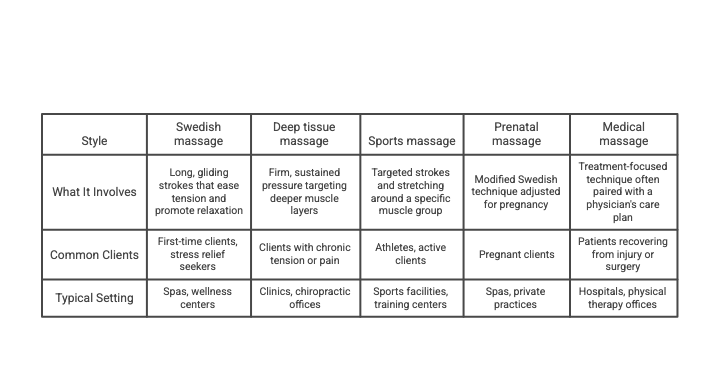
Gwinnett College’s Massage Therapy curriculum covers these modalities directly. Graduates who want a more in-depth understanding of techniques like these can research Gwinnett’s blog, massage therapy techniques and Swedish massage, or visit GALILEO, part of the Georgia Library Online Learning.
Skills for Long-Term Success
Technique carries a massage therapist only so far. Client retention and repeat business depend on skills that no training program can fully teach in a classroom.
Communication separates a therapist who builds a full client book from one who struggles to retain clients. Massage therapists ask about symptoms, medical history, and goals before every session, then adjust technique based on what a client reports.
Physical demands run as high as the technical demands. A full-body massage runs 30 to 90 minutes, and many therapists give several treatments in a row, which puts a premium on stamina, strength, and proper body mechanics.
The Bureau of Labor Statistics also lists decision-making, empathy, integrity, interpersonal skills, and time management among the qualities that shape a massage therapist’s career, since therapists routinely handle private medical information and manage their own appointment schedules.
Because many massage therapists work for themselves, basic business skills, scheduling, marketing, and recordkeeping carry almost as much weight as hands-on technique.
Career Outlook and Earning Potential
Massage therapy ranks among the top health and wellness occupations with above-average projected growth.
The Bureau of Labor Statistics reports a median annual wage of $58,450 for massage therapists as of May 2025, with the bottom 10% earning under $33,640 and the top 10% earning more than $100,200. Employment is projected to grow 15% between 2025 and 2035, adding roughly 20,400 job openings a year, a figure the agency attributes partly to massage gaining acceptance as a treatment for pain management and partly to normal workforce turnover.
Pay varies by setting. Massage therapists working in chiropractic offices earned a median of $72,800 in 2025, compared with $56,230 in personal care services and $43,840 in accommodations. More than a third of massage therapists are self-employed, a structure that adds income variability but removes a ceiling on what a busy, well-reviewed practice can earn.
Those figures describe the profession broadly. The specific path into it, choosing a program, meeting license requirements, finding a path, and building a client base, still determines how quickly a graduate reaches them.
Massage Therapy Training at Gwinnett College
Gwinnett College built its Massage Therapy program around accredited coursework, licensing preparation, and hands-on specialty training.
The program offers a diploma option (12 months in day classes, 18 months in evening classes) and an Associate of Applied Science option (18 months in day classes, 24 months in evening classes) at the Lilburn and Roswell, Georgia, campuses and the Raleigh, North Carolina, campus. Coursework covers anatomy and physiology, Swedish massage, deep tissue technique, hydrotherapy, and sports massage, backed by clinical practicum hours where students work with real clients under instructor supervision before graduation.
Career services support extends beyond the classroom, with resume help, job placement assistance, and interview preparation available to graduates entering the field. Prospective students interested in program dates, tuition, and campus options can request information from Gwinnett College’s admissions team or contact the Lilburn, Roswell, or Raleigh campus directly to schedule a tour.
How to Become a Massage Therapist FAQs
How Long Does It Take To Become a Massage Therapist?
Most training programs run 6 to 24 months depending on award type and class schedule. Gwinnett College’s diploma option takes 12 months in day classes or 18 months in evening classes, and the Associate of Applied Science option takes 18 months in day classes or 24 months in evening classes.
Is It Illegal to Massage Without a License?
In states that regulate the profession, yes. Practicing without the required state license typically violates that state’s massage therapy statute and can result in fines or a cease-and-desist order. Requirements vary by state, so confirming current rules with the relevant state licensing board before accepting clients is the safer route.
Is There a Shortage of Massage Therapists?
The Bureau of Labor Statistics’ data points toward strong hiring demand: 15% projected employment growth from 2025 to 2035 and about 20,400 annual openings, a share of which come from workers leaving the field rather than growth alone.
What Type of Massage Pays the Most?
Bureau of Labor Statistics data show massage therapists working in chiropractic offices earned the highest median wage in 2025, at $72,800, compared with $56,230 in personal care services and $43,840 in accommodations.